
Your Front Desk Isn't Slow — Your Process Is
Insurance verification doesn't fail because staff aren't working hard enough. It fails because the process was never designed to work consistently. Here's how to redesign it.

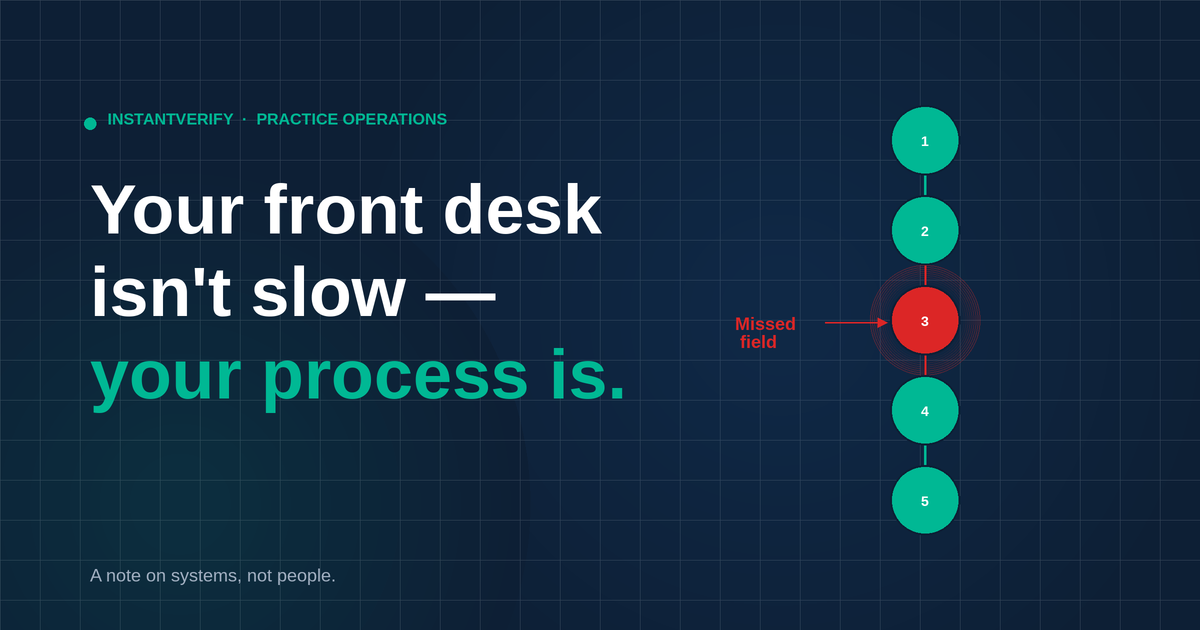
Most practice owners look at verification delays and see a staffing issue. The instinct is to add a person, add a checklist, or add a follow-up reminder. But these solutions address the symptom. The underlying issue is that verification has no defined process — it is assembled differently by different team members on different days.
When the process varies, outcomes vary. A field that gets checked thoroughly on a Tuesday may be skipped entirely on a Friday. The patient experience suffers. Estimates miss. And collections fall short of what the schedule should produce.
What a designed process looks like
High-performing practices treat insurance verification the same way they treat sterilization or scheduling — as a protocol, not a preference. Every appointment triggers the same sequence of steps, in the same order, by the same standard.
That sequence includes not just the basic fields — deductible, annual max, in-network status — but the details that actually affect treatment decisions:
- Waiting periods that may not yet have elapsed for new patients
- Frequency limitations on procedures the patient has had before
- Downgrade clauses that pay composite at the amalgam rate
- Missing tooth provisions that exclude pre-existing gaps
These are the fields that create billing surprises when missed.
The compounding cost of variation
Every time a field is missed, the cost appears somewhere downstream. Sometimes it is a write-off. Sometimes it is a difficult conversation with a patient about an unexpected balance. Sometimes it is a treatment that was accepted based on an inaccurate estimate.
None of these events feel connected to the verification step that caused them. That disconnect is what makes the problem persistent — the failure is invisible until it is expensive.
Where AI changes the equation
Automated verification doesn't make your team faster at doing the same process. It replaces the process entirely for the steps that can be standardized — and flags the ones that require human judgment.
The result is not just speed. It is consistency. Every patient gets the same standard of review, every time, regardless of who is working or how busy the schedule is.
What to look for in your own practice
Review your last 30 days of patient statements. Look for patterns in:
- Unexpected balances
- Write-offs
- Late billing corrections
In most practices, a significant portion of these trace back to a verification field that was either missed or recorded incorrectly.
That pattern is the process problem showing up in financial form.
InstantVerify AI helps dental practices automate insurance verification, eliminate missed fields, and deliver confident benefit estimates every day. Learn more →